

Do I Have To Pay Red Light Camera Ticket In Texas 2018
Lawmakers who banned ruby-red calorie-free cameras, except where they didn't, try to finish the job

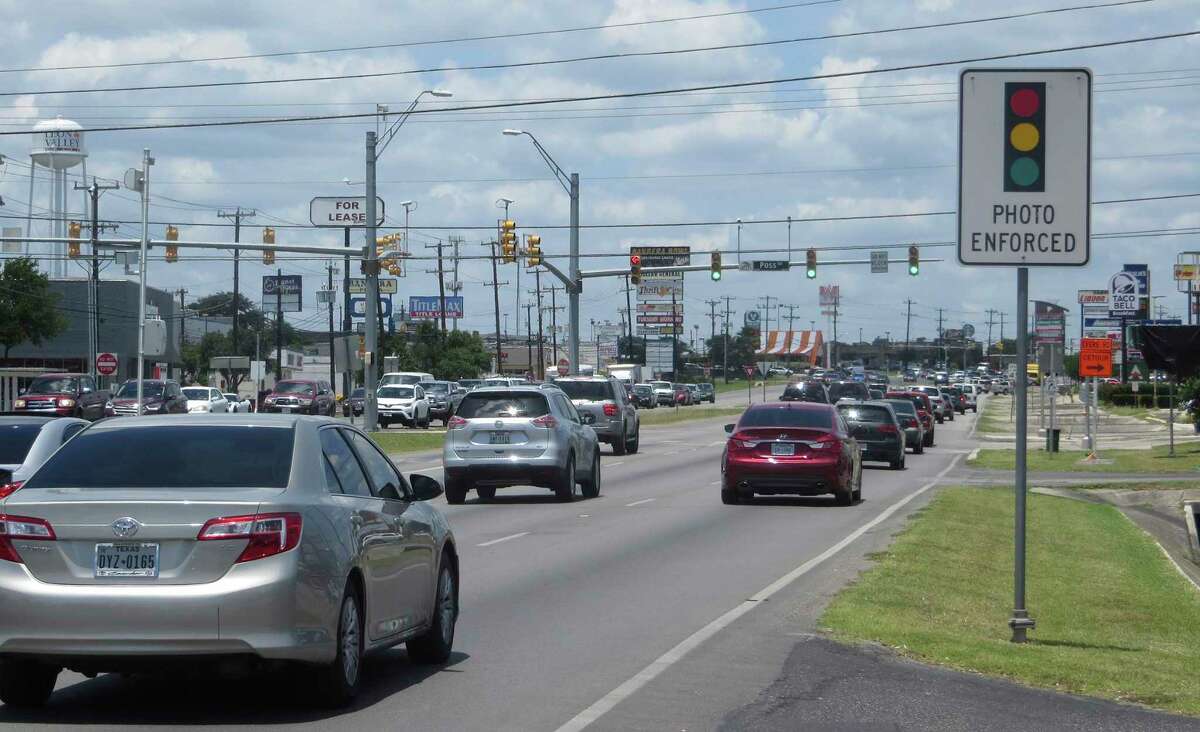
Leon Valley, most San Antonio, began operating red calorie-free cameras at five intersections, shown on Feb. 21, 2018.
Zeke MacCormackStopping blood-red-light cameras completely in Texas is proving harder than it seems.
Lawmakers banned photographic enforcement of intersections in 2019, shutting down hundreds of cameras allowed by the cities around the state. For those who fought bitterly to ban the cameras, it was victory day.
Except for people in four cities, it turned out. The 2019 ban allowed for any city that had a contract with a photo enforcement visitor that did not include termination language related to statewide bans to keep them. Four cities — Humble, Amarillo, Leon Valley and Balcones Heights — fit the bill and continue churning out violations.
Sensing the cameras were soon to come under threat, Leon Valley, nearly San Antonio, took the boggling step in 2019 of extending its contract for 20 years. Quango members who were instrumental in that extension have since been voted out or recalled. Also gone are the city manager and the constabulary master. Nevertheless, the contract stands.
"That was not the intent of what we passed," state Rep. Philip Cortez, D-San Antonio, said.
Cortez at present wants lawmakers to close the door, declaring all 4 contracts nada and void. His House Neb 1209 was heard Tuesday by the House Transportation Committee.
Leon Valley leadership, those unrelated to the earlier contract, came to support Cortez, noting in a survey 80 percentage of the city'southward residents want the cameras gone.
Getting rid of them, notwithstanding, is not a slam dunk with Cortez'south neb, considering lawmakers cannot simply void contracts they do not similar. Section 16 of the Texas Constitution states "no bill of attainder, ex postal service facto law, retroactive law, or whatsoever constabulary impairing the obligation of contracts, shall be made."
So any attempt to void the contracts is likely to atomic number 82 straight to a courtroom.
Cameras remain unpopular in Humble but very active. Metropolis Director Jason Stuebe said the metropolis's contract, which runs through 2024, remains in strength.
Though they were billed as a safe benefit, the cameras' effectiveness at curbing crashes in Humble is unclear. The city has about 400 intersection-related crashes annually, based on 2011-20 information maintained past the Texas Department of Transportation. During the decade, however, traffic volumes and miles traveled in Humble have grown as the population increased, meaning the number of crashes is staying constant while congestion has grown, admitting slightly, based on regional traffic counts.
Crash counts are also erratic at photographic camera locations. Of the three,956 crashes at intersections in the urban center from 2011 to 2020, 386 happened at locations with red light cameras. Annual totals varied from 27 in 2011 — two years afterwards Humble installed cameras — to 75 in 2016, downwards to 29 last year when COVID-19 concise car trips.
While the crash data for the crossings does not bear witness a trend toward fewer wrecks, information technology also does not demonstrate critics' claims of increased rear-end crashes. Simply 37 of the 386 crashes at the intersections were rear-finish crashes, ranging from 8 in 2012 to cipher last year.
Breaking the contract, Stuebe said, would price the city $l,000 per month for the balance of the agreement, a sum the modest city cannot merely blot.
That ways cameras installed by American Traffic Systems, often called ATS, still are up effectually five intersections, generating about $iv one thousand thousand annually for the city, some of which goes to the state and ATS.
"People are yet paying them," Stuebe said of the citations.
Per the metropolis's contract with ATS, those who do non pay are turned over to a collection agency.
That is where a lot of the enforcement stops, notwithstanding.
In response to opponents, lawmakers over the years take stripped virtually all the penalties for not paying crimson-low-cal camera violations. Failure to pay cannot be reported to a credit agency, it has no effect on renewing a vehicle or driver's license and it cannot country the person in ceremonious court.
"If I got one, I'd throw it in the trash," said Jim Spiegel, 60, a former critic of the cameras.
dug.begley@chron.com
Source: https://www.houstonchronicle.com/news/houston-texas/transportation/article/Lawmakers-who-banned-red-light-cameras-except-16133770.php
Posted by: ingramgerry1975.blogspot.com
0 Response to "Do I Have To Pay Red Light Camera Ticket In Texas 2018"
Post a Comment