

When Was The Brownie Camera Invented
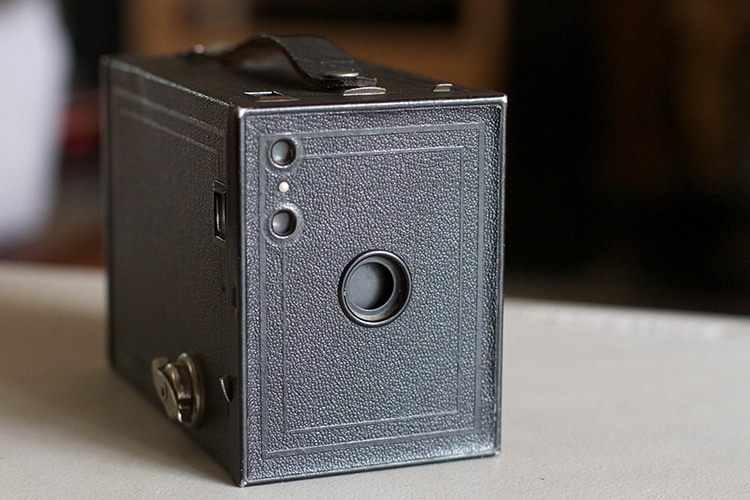
A Kodak Brownie No.ii Model F released in 1924. (Photo: Wikimedia Eatables, Public domain)
This post may comprise affiliate links. If you make a purchase, My Modern Met may earn an affiliate commission. Please read our disclosure for more info.
The start of the 20th century marked the advent of popular personal photography. Previously, commercial photography studios were the only ones producing prints, equally the barrier to entry was high; the materials needed were large, expensive, and required experience. The glass plate negatives and large format cameras were better suited to studio employ than photography on the wing. But this inaccessible nature was nearly to alter due to the business savvy of George Eastman and his Eastman Kodak Company. With years of expertise in crafting cameras and motion-picture show, the company released the legendary Kodak Brownie camera in 1900.
This unproblematic machine distilled the camera to its basic elements, making it cheap and easy to utilise. With a powerful marketing push button to amateurs—especially youth—Kodak sold over 150,000 Brownie cameras in the showtime twelvemonth of production. Over the next lxx years, Kodak congenital upon this success with endless new models and updates.
Millions of Brownie cameras of varying varieties were purchased and made photography an affordable part of everyday life. Equally much as Kodak became synonymous with the heyday of motion picture photography, the Brownie photographic camera became iconic for its snapshots. The ability to capture the small moments of life at a whim proved an important facet of the 20th century.
Read on to larn more near the Kodak Brownie—the camera which got the globe hooked on photography.
The Primeval Kodak Credibility Cameras
Designed by Frank A. Brownell, the unique name is inspired past the mischievous spirits chosen brownies which populated European sociology. The petty sprites presented just the right casual and youthful vibe for what Kodak hoped would be a popular and attainable camera. The original Credibility sold for one dollar ($31 in 2021). The required 117 mm film was likewise affordable, equally was processing your shots past sending them to Kodak or at a local lab.
The original Brownie was produced in 1888 and released in February of 1900. It'southward an case of a box camera. The basic premise is simple; a lens (a pigsty, usually uncovered in the early years) fronts the camera. Many box cameras offered a tab that could be pulled to offer a smaller aperture for brighter light scenarios. Backside the lens is a simple shutter mechanism. Typically only ane shutter speed was available—plus a bulb pick to leave the shutter open.
Each exposure was made by pressing a lever on the side of the camera. At the internal finish of the box, the photographic camera obscura effect exposed the loaded film. The winding knobs on the side of the box allowed the frames to be advanced between shots, and a trivial red window on the dorsum permit the user count their frames. Mod photographers will be accustomed to the viewfinders of a DSLR, but in the days of box cameras, petty mirrored viewfinders on top of the photographic camera were the all-time way to marshal your paradigm.
The negatives produced were originally square—2.25 inches on each side. Over time, new box shapes used unlike size films and produced varying sized negatives.
Kodak produced many versions of their box Brownie camera including the pop No. two, which introduced 120 film. However, due to the incredible success of their new consumer cameras, Kodak began to use that detail film for other types of affordable equipment. It debuted a line of folding cameras that used 120 movie. These cameras had bellows stretching the distance between the lens and the emulsion on the film, thereby producing a big image. However, unlike the box Credibility, the folding Credibility models could be easily folded to exist slipped inside a pocket or briefcase. The folding pocket Brownies and autographic Brownies were produced for years and were very popular.
Plastic and the Mid-Century Credibility
Box Brownies connected to be produced through the 1950s, however other materials were used in new versions of the camera. About important was the constructed plastic Bakelite. Patented in 1909, an early Kodak Bakelite camera was the "Baby Brownie." This minor device was released in 1934 and used 127 film. Like the box Credibility, the mechanism of the shutter, lens, and film advance was very uncomplicated.
Kodak got artistic with their iconic plastic cameras of the Mid-Century period. There are many varieties you can still find for inexpensive on Etsy, eBay, or at garage sales. One fun instance is the Brownie Reflex Synchro which was released in 1941. This camera was in response to the popularity of twin-lens reflex cameras (TLRs). In a true TLR like a Rolleiflex, the shooting lens and the focusing lens are coupled so that the user can focus their image using a ground-glass screen. Merely on the Reflex Synchro, in that location are no focusing options; the prototype can exist roughly framed using the glass screen under the camera's hood.
An iconic mid-century model is the Brownie Eagle Wink which could be coupled with an electric flash. The Bakelite body and mechanisms functioned much like the Babe Brownie and the box Brownies. But with but one discontinuity, i shutter speed, and seedling mode, the Brownie Hawkeye could not focus closer than about five anxiety. The Hawkeye used 620 film, a format developed by Kodak in 1931. It is ordinarily thought this switch from 120 to 620 was a marketing ploy. The emulsive surface of the film is the same, however, the paper bankroll and spool are differently sized. In curt, it benefitted Kodak if all their cameras would only have Kodak film.
Many plastic Credibility models were also created for 127 film—slightly smaller than the 120 format. Amongst these models were the Brownie 127, the Vacation Brownie, and the Credibility Bullet. Once more, the simple mechanisms of the cameras offered ease of use but trivial sophisticated control. 127 motion picture is no longer commercially produced today, but you lot tin can discover sellers on Etsy who cutting downwardly the 120 format. (Some photo suppliers besides carry film adapted to 127 cameras.) While it may seem like there is nothing special to the simple mechanics of the Kodak Credibility, their simplicity, portability, and surprising versatility kept a "Credibility" model camera in production until 1986.
The Kodak Brownie Today
Because of the sheer number produced over the decades, near antique Kodak Brownie cameras are very affordable today. You can find them on Etsy, eBay, or antique stores. You may even want to go through your relative's attic, as virtually anybody had a Brownie camera. Considering the cameras are mechanical, they often still work as new. If y'all buy a Brownie to experiment with a vintage photographic camera, cheque that the shutter still fires, the inside is clean, and the motion picture advance works. If and so, you lot are off to a neat get-go.
Making 127 film on your own is rather complex, but making 120 moving picture work in 620 cameras is simple. You can also re-scroll it onto old 620 spools in a film-changing handbag.
The magic of the snapshots produced by a Brownie camera holds true today. To acquire more about this legendary run of cameras—or to identify one you are not sure virtually—check out this comprehensive list by the The Credibility Photographic camera Guy. If you approach the Brownie expecting vintage magic, you lot won't be disappointed.
Related Articles:
How the Development of the Camera Inverse Our World
The History of Camera Obscura and How It Was Used as a Tool to Create Art in Perfect Perspective
Become an "Instant" History of How Polaroid Revolutionized Photography
Young Student Secretly Photographs People with Hidden Spy Cam in the 1890s
Source: https://mymodernmet.com/kodak-brownie-camera/
Posted by: ingramgerry1975.blogspot.com
0 Response to "When Was The Brownie Camera Invented"
Post a Comment