

Does Georgia Have Red Light Cameras
Bluish Low-cal Facts: Is Blue Light Bad For Your Eyes?
- What is blue light?
- The perils and benefits of UV
- Visible light and blue light
- Key points about blue lite
- Blue light filters and protective eyewear

What is bluish low-cal?
Visible light is more than circuitous than you might think.
Stepping outdoors into sunlight; flipping on a wall switch in your business firm; turning on your computer, telephone or other digital device — all of these things result in your optics being exposed to a variety of visible (and sometimes invisible) light rays.
Nigh people know sunlight contains visible light rays and also invisible ultraviolet rays that can tan or burn your skin. Merely what many don't know is that sunlight contains a broad range of different-colored visible light rays that contain different amounts of energy.
Sunlight contains blood-red, orange, yellow, dark-green and blue light rays and many shades of each of these colors. The colour of individual light rays depends on their energy and wavelength. Combined, the total spectrum of colored visible light rays creates what we call "white light" or sunlight.
Digital electronic devices emit blueish light that can cause eye strain and may lead to heart problems over time.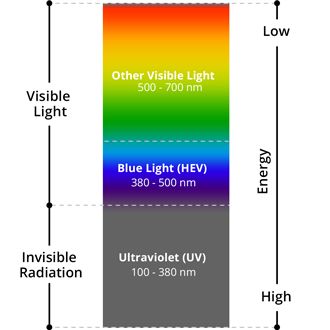
Without getting into complicated physics, at that place's an inverse relationship between the wavelength of a light ray and the amount of energy information technology contains. Light rays that have brusque wavelengths have more than energy and those with longer wavelengths contain less energy.
Rays on the blue stop of the visible calorie-free spectrum take short wavelengths and high free energy. Those on the red cease of the spectrum have long wavelengths and less free energy.
Invisible ray just beyond the ruby terminate of the visible calorie-free spectrum are called infrared radiation. The "warming lamps" you see in restaurants emit infrared radiation. (But these lamps besides emit visible ruby-red light so people know the lamps are on! The aforementioned is truthful for other types of heat lamps.)
On the other terminate of the visible calorie-free spectrum, bluish low-cal rays with the shortest wavelengths (and highest energy) are sometimes chosen blueish-violet or violet light. This is why the invisible rays just beyond the visible lite spectrum are called ultraviolet (UV) radiation.
See RELATED: Does red calorie-free therapy protect the eyes?
The perils and benefits of UV
UV rays take higher energy than visible light rays (including blueish light), which makes them capable of producing changes in the skin that create a suntan. The bulbs in tanning booths emit a controlled corporeality of UV radiation specifically for this reason.
But too much exposure to UV rays causes a painful sunburn — and even worse, can lead to peel cancer. These rays can besides cause sunburned optics — a status called photokeratitis or snowfall incomprehension.
In moderation, even so, UV rays have beneficial effects — such as helping the body manufacture adequate amounts of vitamin D.
Visible light and blueish light
Mostly, scientists say the visible low-cal spectrum comprises electromagnetic radiations with wavelengths ranging from 380 nanometers (nm) on the blueish stop of the spectrum to most 700 nm on the crimson cease. (By the fashion, a nanometer is 1 billionth of a meter — that's 0.000000001 meter!)
Blue light mostly is divers as visible calorie-free ranging from 380 to 500 nm. Blue light sometimes is further broken down into blue-violet light (roughly 380 to 450 nm) and bluish-turquoise light (roughly 450 to 500 nm).
So, near one-third of all visible light is considered high-energy visible (HEV) or "bluish" light.
Key points nearly blue low-cal
Similar ultraviolet radiation, high-energy visible bluish light has both benefits and risks. Here are important things you should know virtually bluish low-cal:
one. Blue light is everywhere.
Sunlight is the principal source of blue calorie-free, and being outdoors during daylight is where we go most of our exposure to it. Simply at that place are many other sources of blue light — including LED lighting and flat-panel screens.
Most notably, the screens of computers, tablets, smartphones and other digital devices produce significant levels of bluish light.
The amount of HEV blueish light these devices emit is but a fraction of that in sunlight. But the amount of time people spend using these devices and the proximity of these screens to the user's face have many middle doctors and other health intendance professionals concerned. Information technology'south possible at that place may be long-term effects of bluish light from computers and phones on the wellness of our eyes.
2. HEV blue light rays make the sky look blueish.
High-energy blue light rays scatter more easily than other visible light rays when they strike air and water molecules in the atmosphere. This greater degree of scattering of blue light is what makes a cloudless sky wait blue.
3. Our eyes are not very good at blocking blue light.
Structures in the forepart half of the eye (the cornea and lens) are very effective at blocking UV rays from reaching the light-sensitive retina at the back of the eyeball. In fact, less than 1% of UV radiations from the sun reaches the retina, even if you lot aren't wearing sunglasses.
(Keep in listen, though, that sunglasses that cake 100% of UV are essential to protect these and other parts of the center from damage that could lead to cataracts, snow blindness, pinguecula, pterygium, and fifty-fifty certain types of cancer.)
On the other hand, almost all visible blueish lite passes through the cornea and lens and reaches the retina.
4. Bluish low-cal might increase the risk of macular degeneration.
The fact that blueish light reaches the retina of the eye is important. Laboratory studies accept shown that too much exposure to blueish light tin damage light-sensitive cells similar those plant in the human retina.
These changes seen in experimental conditions resemble those caused past macular degeneration, which can lead to permanent vision loss.
Although more enquiry is needed to determine how much natural and artificial blueish low-cal from sunlight and digital devices is "too much blueish light" for the retina, many eye care providers are concerned. The added blue light exposure in mod life from computer screens, smartphones and other digital devices might increment a person's gamble of macular degeneration after in life. Until long-term population studies can be washed, it'due south too shortly to tell.
v. Blue light contributes to digital center strain.
Because bluish lite scatters more than easily than other visible light, it's not as easily focused. When we spend hours staring at computer screens and other digital devices, this poorly-focused visual "dissonance" from blue calorie-free reduces contrast and tin contribute to digital middle strain.
Enquiry has shown that lenses that cake high-energy blue calorie-free in the 400-450 nm wavelength range increase contrast significantly. Therefore, calculator spectacles that filter blue-violet calorie-free in this range may reduce middle strain — especially if you utilize digital devices for extended periods of fourth dimension.
vi. Blue light protection is important later cataract surgery.
The lens of an adult centre blocks virtually 100% of the sun's UV rays. As part of the normal aging process, the centre's natural lens somewhen blocks some short-wavelength blue low-cal as well — the blazon of blue lite with the highest potential to damage the retina and possibly crusade macular degeneration and vision loss.
If you have cataracts and are about to have cataract surgery, inquire your surgeon what type of intraocular lens (IOL) will exist used in your process. Some IOLs may be ameliorate than others at restoring some level of blue light protection for your retina subsequently surgery.
Also, when outdoors in daylight, e'er article of clothing sunglasses that block blue lite (also as 100% of the lord's day's UV rays) after cataract surgery. And when using computers and other digital devices for extended periods, wear calculator spectacles that provide better blue calorie-free protection than standard reading glasses.
vii. Not all bluish light is bad.
And so, is all blue light bad for you lot? Why not block all bluish light, all the time?
Actually, some blue light exposure is essential for expert wellness. So 100% protection from all bluish lite is not a good thought. Enquiry as well has shown that high-energy visible light boosts alertness, helps memory and cognitive function, and elevates mood.
In fact, the awarding of controlled levels of blue lite is sometimes used to treat a status chosen seasonal melancholia disorder (Deplorable). This is a blazon of depression that's related to changes in seasons, with symptoms usually beginning in the fall and continuing through wintertime.
The calorie-free sources for this therapy emit bright white light that contains a significant corporeality of HEV blue lite rays.
Also, blue light is very important in regulating cyclic rhythm — our natural wakefulness and slumber cycle. Exposure to blue low-cal during daytime hours helps maintain a healthful circadian rhythm.
But too much blue lite late at nighttime (such every bit reading an due east-book or browsing the spider web at bedtime) can disrupt circadian thythm, potentially causing sleepless nights, daytime fatigue, and even serious wellness problems.
Blue lite filters and protective eyewear
If y'all are constantly using your phone for texting, emailing and web browsing, a convenient fashion to reduce your blueish light exposure is to utilise a blueish light filter to the screen of your device.
Digital electronic devices emit bluish light that tin can cause heart strain and may lead to eye problems over time.
These filters are available for smartphones, tablets, and figurer screens and are bachelor wherever electronics are sold.
Blue lite filters reduce the corporeality of HEV blue light emitted from these devices from reaching your optics without affecting the visibility of the display. Some are fabricated with sparse tempered drinking glass that besides protects your device's screen from scratches.
Equally mentioned above, blue light-blocking computer glasses can also exist helpful to reduce blue light exposure from digital devices. These special-purpose glasses are bachelor without an eyeglass prescription if you don't need corrective lenses or if you routinely wear contact lenses to correct your eyesight.
If you have even balmy nearsightedness, farsightedness or astigmatism, prescription calculator glasses tin optimize your vision specifically for the distance from which y'all view your devices. This is especially important if y'all also have historic period-related presbyopia.
If you lot're over age forty and routinely vesture progressive lenses or bifocals, prescription calculator glasses with unmarried vision (i-power) lenses optimized for your computer viewing distance give you the additional do good of a much larger field of view for seeing your entire screen conspicuously. Proceed in listen, though, that this blazon of reckoner eyewear is exclusively for seeing objects within arm's length and should not exist worn for driving or other altitude vision needs.
Also, some anti-reflective coatings for eyeglasses and calculator spectacles (such every bit Essilor'south Crizal Prevencia AR Blanket) provide an added degree of blueish calorie-free protection from sunlight and digital devices.
You may besides desire to consider photochromic lenses, which provide UV and bluish lite protection indoors and automatically darken in sunlight to increase comfort and reduce glare outdoors.
Run into your center doctor or optician for more advice on the best computer glasses for viewing your screens and protecting your eyes from blue lite.
Page published in February 2019
Folio updated in January 2022
Medically reviewed in May 2021

Source: https://www.allaboutvision.com/cvs/blue-light.htm
Posted by: ingramgerry1975.blogspot.com
0 Response to "Does Georgia Have Red Light Cameras"
Post a Comment