

How Does Digital Cameras Work
Have you lot ever wondered what is a camera, and how does a camera piece of work? How does that piece of delicate machinery work when y'all take a photo? You are non alone.
Cameras accept evolved a lot in the by one-and-a-half century. Photography has inverse drastically. Today's mod cameras are the result of countless years of development, merely the base principles remain the same.
So how does a camera work? Hither's our guide.
 [Note: ExpertPhotography is supported by readers. Product links on ExpertPhotography are referral links. If y'all apply one of these and buy something, we make a picayune bit of coin. Need more info? Encounter how it all works here.]


What Is the Office of Light?
If we want to understand how does a camera piece of work, we demand to know how does lite work. Photography would not exist without our understanding of calorie-free.
Without diving further into wild territories of physics, let's make the nuts clear.
Light travels in a straight path. Information technology doesn't take curves (at least practically for us, photographers). Information technology gets reflected and absorbed.
For our eyes and cameras, light is a moving ridge. Information technology has very much the same backdrop as sound – information technology varies in wavelength, frequency, and aamplitude. It differs in energy level.
The task for the photographer is to collect and capture the light in their ain taste and class.
Core Concept of Cameras
Aside from the very showtime pinhole cameras (which don't have drinking glass), the two chief parts of cameras are the lens and the light detector.
The camera lens collects light and projects it onto a light detector surface – film or digital sensor.
Then, through various ways of processing, you get your final image that is shaped to your taste.
Photography is all that happens between these steps – and even before that.
And you, the photographer, accept command over it.
The Lens
The lens is the get-go encounter of the light with the camera.
Light passes through the lens. Through different optical formulas, information technology crafts the manner the paradigm is projected. Information technology is one of your most powerful tools of expression – so information technology's vital that you understand how it works.
Optical Construction
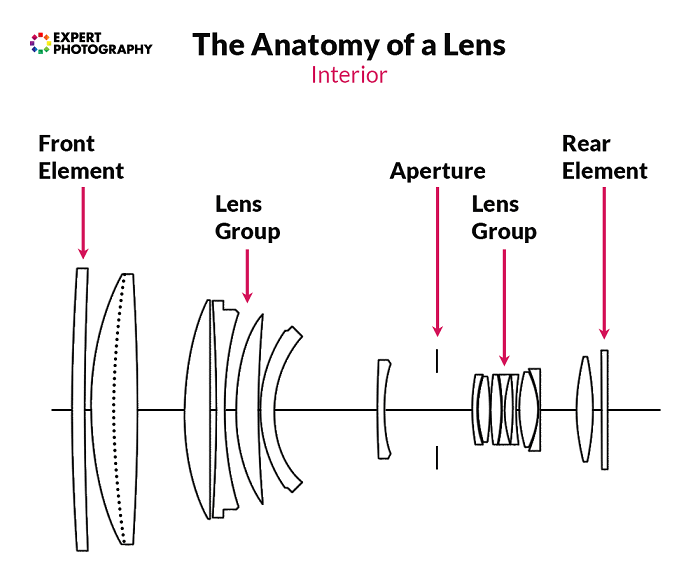
Your camera lens is actually not one lens. Information technology'south fabricated up of numerous single lenses and lens groups.
The construction is the effect of meticulous designing and testing. There are some standard formulas, like the 50mm f/one.8 or f/ane.4. These are very similar throughout different manufacturers and have been adult long ago.
Some advanced and farthermost camera lenses have formulas that weren't possible until only recently.
The optical formula of a lens determines the image it can project onto a sensor.
Focal Length
In simple terms, focal length defines the amount of zoom. A lower focal length gives a wider angle of view. A higher – "longer" – focal length gives a narrower crop of the scene.
In technical terms, the focal length is the altitude between the betoken of convergence of the lens and the sensor or film.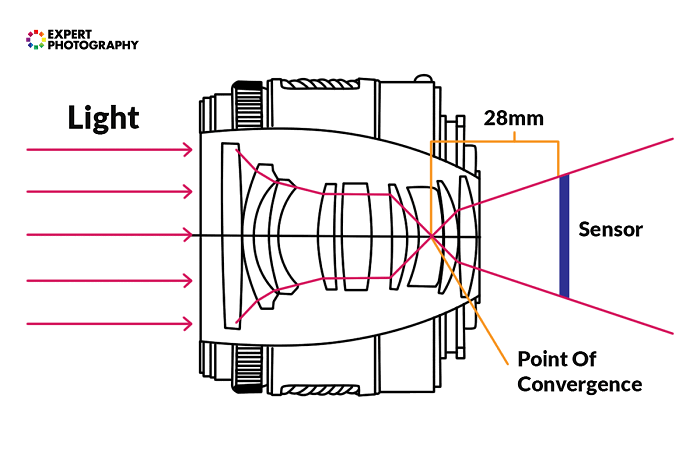
It's practically impossible to design a lens with its betoken of convergence earlier the front element, only it tin be behind that. This ways that telephoto lenses must actually be longer (with the exception of mirror lenses). Yet, broad-bending lenses can be surprisingly long.
Zoom lenses change their point back and forth. Prime lenses accept theirs fixed, and the elements only move for focusing.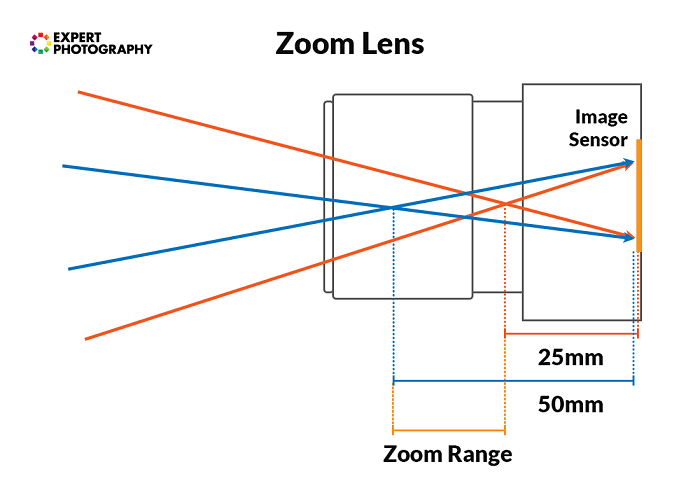
Aperture
The diameter of the lens determines the maximum amount of calorie-free that can laissez passer.
In most lenses, there is an iris. The iris is used to narrow down the diameter. Information technology works like the pupil in your eye: the narrower it is, the less calorie-free information technology lets in.
Also, with tighter iris comes a deeper depth of field and less groundwork separation.
The aperture value is given in the grade of F-stops. The F-stop is a ratio. Y'all can calculate it by dividing the focal length with the diameter of the lens (at the iris).
For instance, the F-terminate of a 50mm lens with a 25mm aperture diameter is f/2.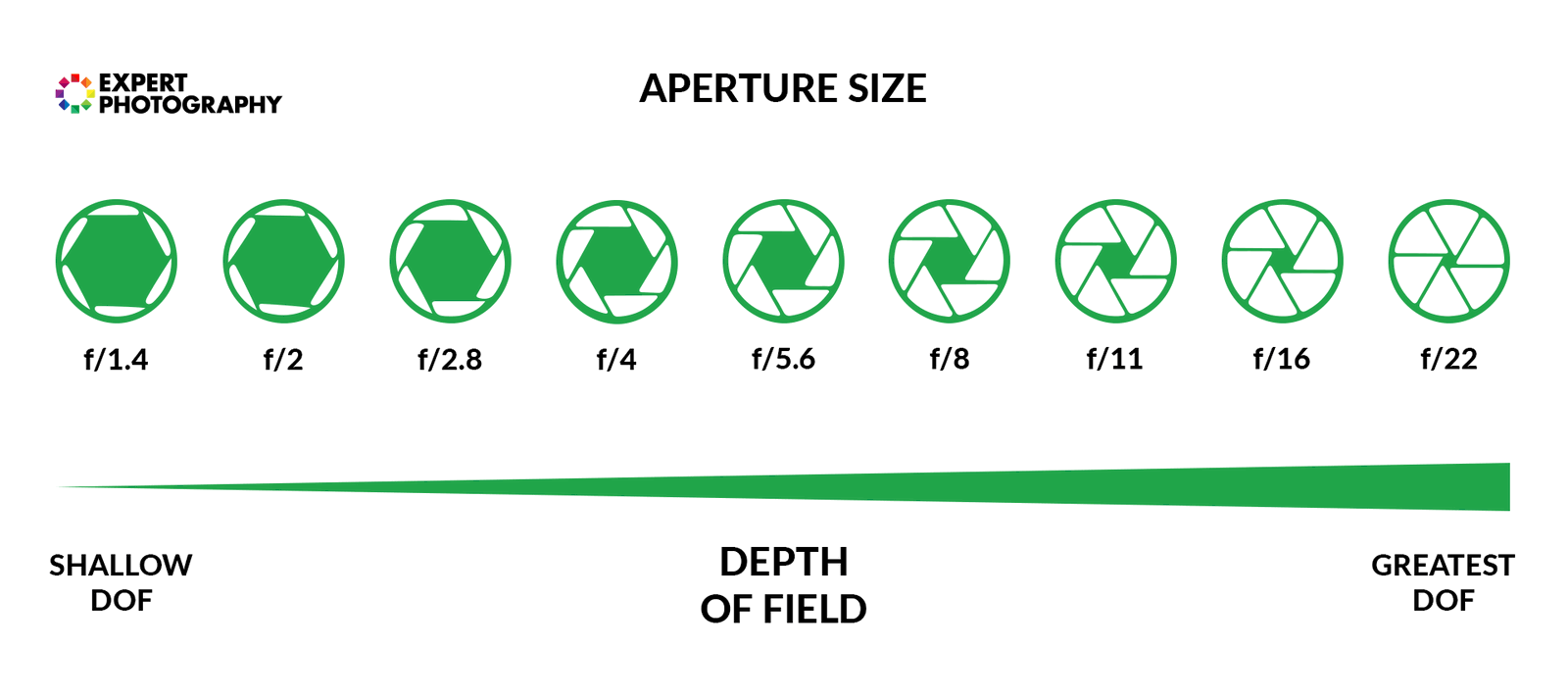
Of grade, when yous zoom, focal length changes. In lenses with a constant minimum aperture value – for instance, a 24-70mm f/two.8 – the aperture gradually opens upward as you zoom in. This keeps the ratio the same throughout.
Focusing
Like your center, a camera lens sees the world in focal planes. These planes are parallel to the front end element of the camera lens and (in nearly cases) to the sensor. The exceptions are tilt-shift and extremely broad-bending lenses.
To get a certain aeroplane in focus, a lens element must move inside the lens. You can command this element with autofocus or manually past turning the focusing band.
There is a focusing range that each lens is capable of. The closer the focusing chemical element gets to the sensor, the farther information technology focuses.
Except for macro-only lenses, most go to infinity focus. Infinity is the aeroplane across which practically everythingis in perfect focus. Physically it'southward possible to go further – but it doesn't make sense since, after that, the image gets blurry again.
When shooting shut-up, the focusing chemical element gets away from the sensor. Hence, information technology'southward possible to make whatsoever not-macro lens capable of macro by adding extension tubes between the torso and the lens.
Normally, the focusing ring is physically connected to the focusing machinery inside the lens. In that case, manual focus gives yous direct control. In some lenses, there is just electronic control.
This happens in heavy lenses (like Canon's 85mm f/1.2 Two). In tiny constructions, where a normal focus ring would be impractical anyway (like the Canon 40mm f/two.eight pancake lens), it'south also frequently used.
Stabilization
In some modernistic lenses, yous volition discover an element that actively stabilizes the motility of the photographic camera. This part is usually a structurally distinct block at the dorsum with one lens.
With the help of a gyroscope, it meters and counteracts your handshake and other movements.
The naming of stabilization systems differs from brand to brand. Canon calls theirs IS (Image Stabilizer), Nikon has VR (Vibration Reduction), Sony has OSS (Optical SteadyShot), and and so on. They all do the aforementioned for the most part.
Weight and Ergonomics
The size and weight of lenses depend on plenty of factors.
Usually, faster aperture means bigger lenses. Wide zoom range also results in longer lenses when zoomed in, but they are often retractable.
Also, the bigger the intended sensor size is, the bulkier the lens has to be.
Stabilization likewise comes with higher weight.
Most often, manufacturers design their lenses to provide great balance with their cameras. But in some cases, this is not possible. Fast telephoto and super-telephoto lenses (like the Canon 200mm f/2) and fast ultra-wide-angle lenses (like Sigma'due south 14mm f/i.viii) must accept huge front elements, so they may feel unbalanced.
Connection to the Photographic camera Body
In this sense, there are 2 types of camera lenses: interchangeable and fixed to the body.
Fixed lenses are generally found on consumer-level compact and bridge cameras. Some brands, for instance, Leica, are making top-level fixed-lens cameras.
In that location aren't many options with fixed lenses – you get what you get.
However, on DSLRs (Digital Single-lens Reflex) and MILCs (Mirrorless Interchangeable Lens Camera), you can alter the camera lenses independently from camera bodies.
For connecting their lenses to their camera bodies, each camera manufacturer (or brotherhood) has standard lens mounts.
Besides holding the lenses condom and steady, each mount has an electronic protocol as well. This is necessary to provide ability for autofocus and stabilization. Data links also transfer aperture, focus distance, zoom, and general lens information.
Nearly notable photographic camera mount types include the Canon EF/EF-S (DSLR), EF-G (cropped-sensor mirrorless), and RF (full-frame mirrorless), as well as Nikon's F (DSLR) and Z (mirrorless), Sony's A (DSLR) and E (mirrorless), and much more.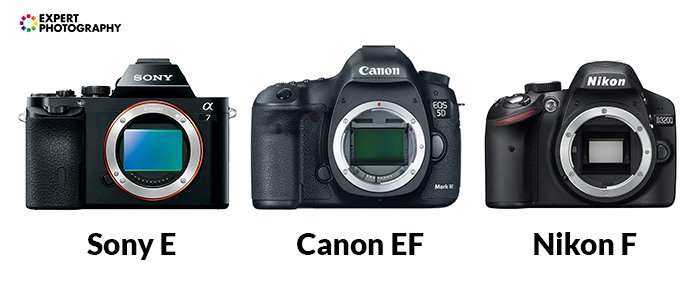
Cameras
Subsequently going through the lens, light arrives at the camera, where it gets detected past a sensor or film.
Viewfinder
All DSLRs and many mirrorless cameras have viewfinders. Information technology tin be optical or and electronic.
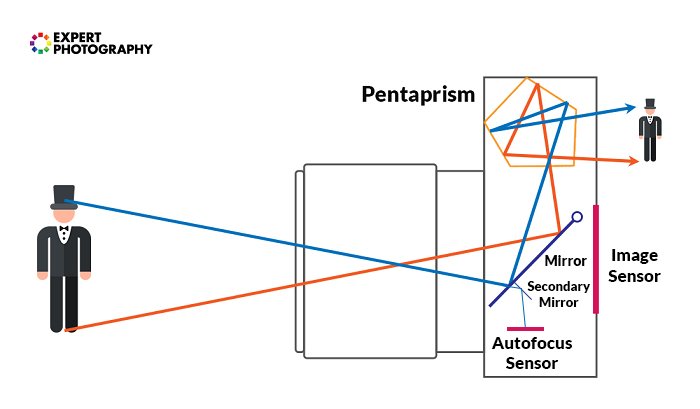
In a DSLR digital camera with the optical viewfinder, in one case the light arrives from the lens, information technology bounces onto a semipermeable mirror. Almost of the light then reflects up to a pentaprism and so to the viewfinder.
Some of the light reflects downwards through a secondary mirror into the autofocus sensor.
In a mirrorless camera, there is no optical connection between the lens and your eye. The light ever goes direct onto the sensor.
From the sensor, the alive view is transmitted digitally to the electronic viewfinder (EVF) or to the back screen.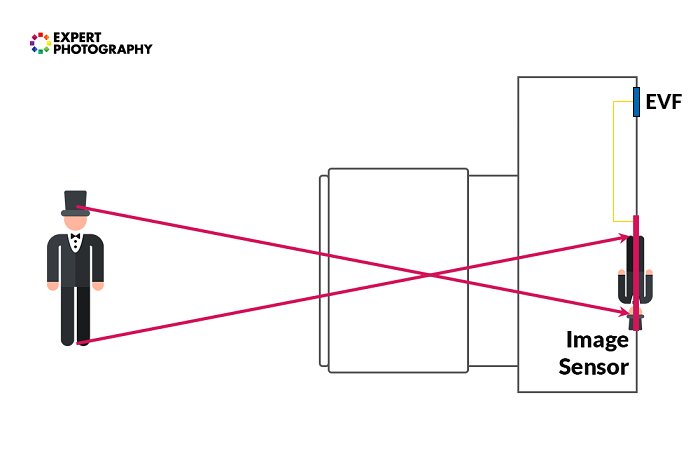
Shutter
The shutter is the mechanism that lets the calorie-free onto the film or sensor for a set amount of fourth dimension (the shutter speed).
Before the digital camera age, the only pick was a mechanical shutter. They physically move an obstruction in the way of light.
Rolling mechanical shutter, which is found in most cameras, has two defunction. When you printing the shutter button, the first mantle slides upwards and lets the light onto the camera sensor. So, afterward the set time of the shutter speed, the second curtain shuts. The sensor is blocked once again.
One of the rolling shutters' disadvantages is that you can't use a standard flash below a sure shutter speed. This is normally around 1/200th of a 2nd. Below that, they are not exposing the whole frame at the same time.
There's a window between the defunction that travel from on side to the other.
In plough, a wink is instantaneous, so if you drop below that speed, merely a band of the frame will be lit. You can avoid this problem by using Loftier Speed Sync.
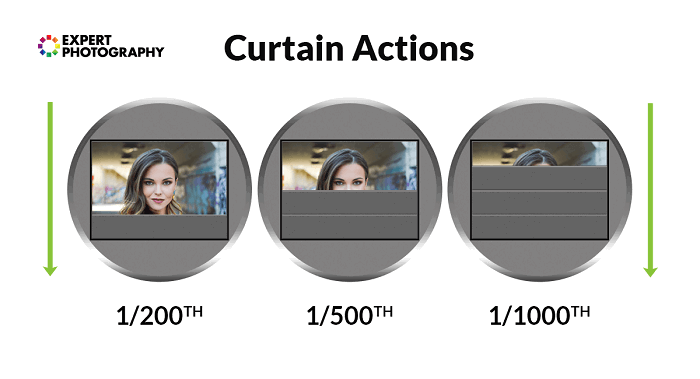
Electronic shuttersare a product of the digital camera era. They are used for quick, continuous image readout.
A rolling electronic shutter is found in nearly every digital camera. It works by gathering the information from the sensor in blocks (normally, rows of pixels), proceeding downward.
This allows for silent shooting and very low shutter speeds, in some cases ane/32000th of a second. The downside is that fast-moving subjects appear distorted because of the asynchronous readout.
Live View and video recording both use electronic shutters in consumer-level cameras.
In some avant-garde cameras, you will find a global electronic shutter. It reads the data from the whole frame simultaneously, solving the problem of banding distortion. It's mostly used for professional video recording.
Sensor
Digital sensors are composed ofpixels. Pixels are tiny solar cells that convert calorie-free into electricity.
About digital cameras characteristic a standard single-layer CMOS or CCD sensor. CMOS is a newer technology that allows for individual pixel readout and low power consumption.
Pixels are laid out in an system chosen the Bayer mosaic using colour filters. The Bayer mosaic consists of blocks of four pixels, 2 green, ane red and one blue.
Since each pixel is but sensitive to its ain color, the end upshot is an paradigm with scattered carmine, light-green, and blue dots.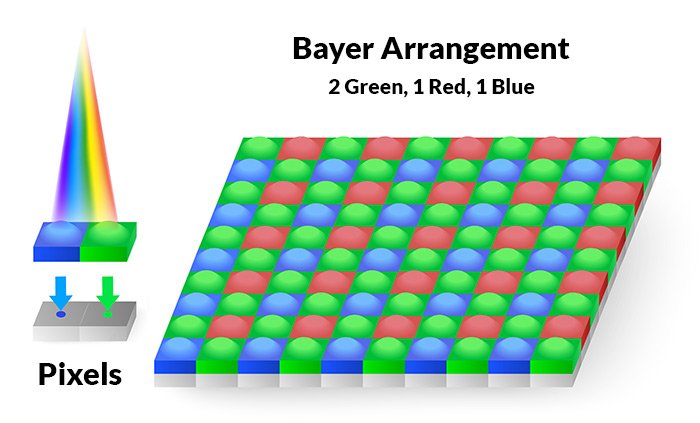
To get gradual tones and a smoothen photograph, the processor or your editing software volition have to perform debayering.
ISO Sensitivity
In moving picture cameras, you bandy the film for a unlike sensitivity film. In digital cameras, it'south a dissimilar process.
When you lot (or your camera) set the ISO value, multiple things can happen depending on your camera and the exact ISO value.
Cameras with CMOS sensors (most digital cameras) have a tiny amplifier for each individual pixel. Afterward the frame is exposed, information technology amplifies the pixels to a college level, according to the ISO.
Until a certain value, usually ISO 1600, this is the simply amplification.
Beyond that, ISO is a digital tag that is embedded in the raw file or a digital amplification for jpg files.
Digital Conversion and Processing
Later on readout from the digital camera sensor and going through the amplifier, the information is converted to digital information. This is the task of the analog-to-digital converter.
About modern cameras convert to 16-bit just using only 14 bits of that. The extra 2 bits let for more than flexibility in post-production and filtering.
14 bit ways that for every pixel there are sixteen.384 possible values. This results in immense color and tonal range in modern digital cameras.
The pixel data then proceed to theepitome processor. The processor performs several algorithms, filtering, debayering, and compresses if you're choosing jpg output.
The final image is and so written onto your card.
Conclusion
You at present have a deeper understanding of how exercise cameras work. You tin implement this noesis in everyday situations, as well as for deciding on difficult technical questions.
Understanding how your camera works opens upward more possibilities in using your gear and utilizing its capabilities.
Source: https://expertphotography.com/how-does-a-camera-work/
Posted by: ingramgerry1975.blogspot.com
0 Response to "How Does Digital Cameras Work"
Post a Comment